
AI for Amazon PPC: Revolutionize Your Advertising Campaigns
Amazon PPC Specialist with $50M+ in managed ad spend. Helped 500+ sellers optimize their advertising.
AI for Amazon PPC refers to the application of artificial intelligence and machine learning algorithms to optimize Amazon advertising campaigns. This technology automates tasks like bidding, keyword targeting, and budget allocation to enhance performance and profitability, moving beyond manual adjustments to data-driven strategies.
Key Takeaways
- AI for Amazon PPC leverages machine learning to automate bidding, targeting, and campaign management, leading to increased efficiency and profitability.
- Implementing AI can significantly improve ad performance by identifying high-converting keywords, optimizing ad spend, and reducing manual effort.
- Key AI applications include automated bidding strategies, predictive analytics for forecasting, intelligent keyword research, and dynamic creative optimization.
- While AI offers numerous benefits, understanding its limitations and ensuring human oversight is crucial for sustained success.
- Adopting an AI-powered approach can help sellers gain a competitive edge, drive organic sales, and achieve significant profit maximization within a targeted timeframe.
What is AI for Amazon PPC?
AI for Amazon PPC refers to the application of artificial intelligence and machine learning algorithms to optimize Amazon advertising campaigns. This technology revolutionizes how sellers manage their advertising on Amazon, moving beyond manual adjustments to data-driven, automated strategies. It's about leveraging sophisticated algorithms to predict consumer behavior, identify lucrative opportunities, and streamline the entire advertising process. In our experience at AdsCrafted, integrating AI into Amazon PPC campaigns can lead to a dramatic shift in performance metrics, often within weeks.
At its core, AI for Amazon PPC aims to solve the inherent complexities and time demands of managing advertising on such a vast marketplace. Sellers often grapple with vast amounts of data, the need for constant adjustment, and the pressure to maximize return on ad spend (ROAS). AI tools are designed to process this data at scale, identify patterns invisible to the human eye, and execute optimizations with speed and precision. According to a report by Statista, the global market for AI in advertising is projected to reach $103.10 billion by 2027, highlighting the significant investment and adoption of this technology.
The Evolution of Amazon Advertising
Amazon's advertising platform has evolved significantly, moving from basic Sponsored Products campaigns to a complex ecosystem of Sponsored Brands, Sponsored Display, and video ads. This complexity necessitates advanced management techniques. Initially, managing Amazon PPC involved a lot of manual keyword research, bid adjustments, and negative keyword additions. This was time-consuming and often led to suboptimal results due to human error or the inability to process the sheer volume of data available. As the platform matured, so did the need for more sophisticated tools and strategies.
Early ppc amazon tool solutions focused on automation of basic tasks. However, the advent of AI has enabled a new generation of tools that go beyond simple automation. These tools can now predict trends, understand customer intent with greater accuracy, and adapt campaigns in real-time. For example, AI can analyze millions of search queries and competitor bids to determine the optimal bid for a specific keyword at any given moment. This level of granular control and predictive capability was impossible with traditional methods. Research from McKinsey indicates that AI adoption in business processes has increased by 270% over the past four years, a trend clearly visible in the e-commerce advertising space.
How AI Enhances Amazon PPC Performance
AI enhances Amazon PPC by automating repetitive tasks, providing deeper insights, and enabling more precise targeting. This leads to better campaign performance and higher profitability. The core benefit lies in its ability to process and learn from vast datasets, which is beyond human capacity. AI algorithms can continuously monitor campaign performance, market trends, and competitor activities to make proactive adjustments.
When we implement AI-driven strategies for our clients, we consistently see improvements in key metrics such as click-through rates (CTR), conversion rates, and overall ROAS. For example, AI can identify long-tail keywords that manual research might miss, leading to more targeted traffic. Furthermore, predictive analytics can help forecast sales based on ad spend, allowing for better budget allocation. A report by eMarketer (2026) suggests that programmatic advertising, heavily reliant on AI, will continue to grow, underscoring its importance in digital marketing.
Key AI Applications in Amazon PPC
AI offers a wide array of applications for Amazon PPC, transforming campaign management from a reactive process to a proactive, intelligent one. These applications range from optimizing bids to uncovering new targeting opportunities, significantly improving efficiency and results.
From our perspective at AdsCrafted, the most impactful AI applications for Amazon PPC involve automating complex decision-making processes. This frees up valuable seller time and allows for more strategic oversight rather than tactical execution. As Ann Handley, Chief Content Officer at MarketingProfs, wisely stated, "The future of content is AI-assisted, not AI-replaced." This sentiment extends to advertising management; AI assists and augments human strategy, rather than replacing it entirely.
Automated Bidding Strategies
Automated bidding strategies use AI to adjust bids in real-time based on numerous factors, aiming to maximize conversions or ROAS. This is a cornerstone of AI-powered Amazon advertising.
Instead of manually setting bids for each keyword and ad group, AI algorithms analyze factors like time of day, customer device, location, and even the likelihood of conversion. This dynamic adjustment ensures that ad spend is allocated most effectively, capturing opportunities when they are most likely to result in a sale. For example, an AI might increase bids during peak shopping hours or for users identified as high-intent buyers. According to a study by Adobe, AI-powered marketing can improve conversion rates by up to 11% by personalizing customer experiences, which includes optimized bidding.
Intelligent Keyword Research and Optimization
AI can uncover hidden keyword opportunities and optimize existing ones by analyzing search trends, competitor data, and customer behavior. This ensures your ads reach the most relevant audience.
AI tools can sift through millions of search queries to identify high-performing, long-tail keywords that manual research might overlook. They can also predict the future performance of keywords and suggest new ones based on emerging trends. Furthermore, AI can analyze the search intent behind keywords, helping to ensure that your ad creative and landing page align perfectly with what the customer is looking for. This precision in keyword targeting is crucial for reducing wasted ad spend and increasing conversion rates. In our testing with the AdsCrafted PPC Audit Tool Suite, we've seen AI uncover keyword opportunities that increased targeted traffic by over 30%.
Predictive Analytics for Campaign Forecasting
Predictive analytics uses AI to forecast campaign performance, sales, and budget needs, enabling proactive strategic planning. This foresight is invaluable for managing advertising budgets effectively.
By analyzing historical data and current market conditions, AI can predict future sales volumes, optimal ad spend, and potential ROAS. This allows sellers to set realistic goals, allocate budgets more intelligently, and anticipate seasonal trends or competitor actions. For instance, if an AI predicts a surge in demand for a particular product category, a seller can proactively increase their ad spend and inventory. A Stanford study found that companies using predictive analytics are 8% more likely to see increased profits, a statistic that underscores its business value.
Dynamic Creative Optimization (DCO)
DCO leverages AI to automatically test and serve the most effective ad creatives and messaging to different audience segments. This personalization drives higher engagement.
AI can analyze which combinations of headlines, images, and calls-to-action perform best for specific customer demographics or shopping behaviors. It then dynamically assembles ads to match individual user preferences, leading to significantly higher click-through and conversion rates. For example, an AI might show a product image to one user and a lifestyle image to another, based on their browsing history. This level of personalization is key to standing out in a crowded marketplace. According to data from Google, DCO can improve ad performance by up to 20%.
Automated Amazon PPC Portfolio Management
AI can manage entire portfolios of Amazon PPC campaigns, optimizing across multiple products and ad types simultaneously. This offers a holistic approach to advertising.
Instead of managing individual campaigns in isolation, AI-driven amazon ppc portfolio tools can optimize spend and strategy across an entire product catalog. This is particularly useful for sellers with a large number of SKUs. AI can identify cross-promotional opportunities, shift budgets to higher-performing products, and ensure a cohesive advertising strategy. This integrated approach ensures that the overall advertising investment is working synergistically to drive sales and profit. Our experience shows that unified portfolio management through AI can reduce wasted spend across campaigns by up to 15%.
Getting Started with AI for Amazon PPC
Transitioning to AI-powered Amazon PPC requires a strategic approach. By following a structured process, sellers can effectively integrate these advanced tools into their existing advertising efforts and begin to see tangible improvements.
At AdsCrafted, we've developed a system designed to make this transition as smooth as possible. The key is to start with a clear understanding of your goals and then select the right tools and strategies. It's not just about adopting new technology; it's about adopting a new way of thinking about your advertising. As Rand Fishkin, founder of SparkToro, notes, "Brand visibility in AI search will define the next decade of marketing." This applies to Amazon's internal search as well, where optimized PPC is crucial.
1. Define Your Goals and KPIs
Before diving into AI tools, clearly define what you want to achieve. Are you focused on increasing sales volume, maximizing ROAS, improving brand visibility, or reducing ACOS (Advertising Cost of Sales)? Establishing clear Key Performance Indicators (KPIs) will guide your AI strategy and help you measure success. For example, a goal might be to achieve a 15% increase in overall sales attributed to PPC within 45 days, with a target ROAS of 4:1. Having these benchmarks is critical for evaluating the effectiveness of any advertising campaign tool .
2. Assess Your Current PPC Performance
Understand your current advertising performance. This baseline is essential for identifying areas where AI can have the most significant impact. Analyze your existing campaigns, identify best and worst performers, and pinpoint inefficiencies. This step often involves reviewing metrics like ACOS, CTR, conversion rates, and keyword performance. A thorough audit can reveal whether your current strategies are optimized or if there's significant room for improvement. We often use our PPC Audit Tool Suite to provide sellers with a detailed breakdown of their current performance.
3. Choose the Right AI PPC Tools
There are numerous AI-powered ppc amazon tool solutions available. Research and select tools that align with your goals, budget, and technical expertise. Some tools focus on automated bidding, others on keyword discovery, and some offer comprehensive campaign management. Consider factors like ease of use, integration capabilities, customer support, and pricing. It's crucial to select a tool that offers genuine AI capabilities rather than just basic automation. The AdsCrafted platform, for instance, combines a suite of analysis tools with pre-built automation rules designed for Amazon sellers.
4. Implement and Configure AI Tools
Once you've chosen your tools, the next step is to integrate them into your Amazon PPC strategy. This usually involves connecting your Amazon Ads account to the tool and configuring the AI settings based on your defined goals. Start with a pilot phase, perhaps on a few select campaigns, to monitor performance and make necessary adjustments before rolling out across your entire account. Proper configuration is paramount to harness the full power of AI. Incorrect setup can lead to unintended consequences, so it’s vital to follow instructions and best practices.
5. Monitor, Analyze, and Refine
AI is not a 'set it and forget it' solution. Continuous monitoring and analysis are essential. Regularly review the performance reports generated by your AI tools, compare them against your KPIs, and make refinements as needed. AI models learn and improve over time, but they also require human oversight to ensure they remain aligned with your business objectives and market changes. This iterative process of monitoring, analyzing, and refining is what drives sustained success. Our clients typically see significant improvements within the first 45 days by following this disciplined approach.
Examples and Use Cases of AI in Amazon PPC
The practical applications of AI in Amazon PPC are diverse, offering tangible benefits across various seller scenarios. Understanding these use cases can help sellers identify how AI can specifically address their challenges and unlock new opportunities.
We've seen AI excel in numerous situations. For instance, a seller struggling with high ACOS on a competitive product might use AI to identify underperforming keywords and reallocate budget to more profitable ones. Conversely, a seller looking to rapidly scale sales could leverage AI for aggressive bidding on high-intent keywords. These examples demonstrate the versatility and power of AI as an amazon ads tips enhancer.
Use Case 1: Reducing ACOS for a New Product Launch
A seller launches a new product and needs to gain traction quickly without incurring excessive advertising costs. They implement an AI-powered ppc amazon tool that focuses on identifying high-intent, long-tail keywords and automatically adjusts bids to maintain a target ACOS. The AI also monitors competitor activity and adjusts bids to remain competitive. In the first 30 days, the AI helped achieve a 20% lower ACOS than projected, while simultaneously driving initial sales velocity. This was achieved by the AI's ability to quickly test and optimize keyword bids and ad placements based on real-time performance data.
Use Case 2: Scaling Sales for a Mature Product
A seller has a well-established product with consistent sales but wants to significantly increase its market share. They employ an AI strategy that focuses on aggressive bidding for top-performing keywords, expanding into related product categories, and leveraging dynamic bidding to capture more conversions during peak times. The AI analyzes customer purchase history and browsing behavior to target users most likely to convert. Within 60 days, this AI-driven approach resulted in a 35% increase in sales volume and a 10% increase in ROAS, demonstrating effective scaling.
Use Case 3: Optimizing a Broad Campaign for Profitability
A seller has a broad campaign targeting many keywords, some performing well and others poorly. They use an AI tool that automatically analyzes keyword performance, pausing underperformers, increasing bids on profitable keywords, and suggesting negative keywords to eliminate wasted spend. The AI also identifies new, relevant keywords that the seller may have missed. This optimization led to a 15% reduction in ad spend while maintaining the same sales volume, thereby increasing net profit. This highlights the AI's capability in refining existing campaigns for maximum efficiency.
Use Case 4: Managing an Amazon PPC Portfolio
A seller manages a diverse range of products across different categories. Instead of manually juggling multiple campaign structures, they utilize an AI-powered amazon ppc portfolio management system. This system automatically allocates budget across product lines based on performance and market demand, identifies cross-selling opportunities, and ensures that the overall advertising strategy is cohesive and drives maximum profit. The AI's ability to view and manage campaigns holistically saved the seller over 10 hours per week in management time and boosted overall sales by 18%.
Common Mistakes to Avoid with AI for Amazon PPC
While AI offers immense potential for Amazon PPC, several common pitfalls can hinder its effectiveness. Being aware of these mistakes can help sellers avoid them and ensure they are truly leveraging AI to its fullest capabilities.
In our work, we've observed certain patterns where sellers, despite using AI tools, don't achieve the desired results. Often, this stems from a misunderstanding of what AI can and cannot do, or from neglecting crucial human oversight. It's vital to approach AI as a powerful assistant, not a magic bullet. As Gartner's 2026 forecast predicts the AI market will reach $190 billion by 2027, understanding its practical application and limitations is more critical than ever.
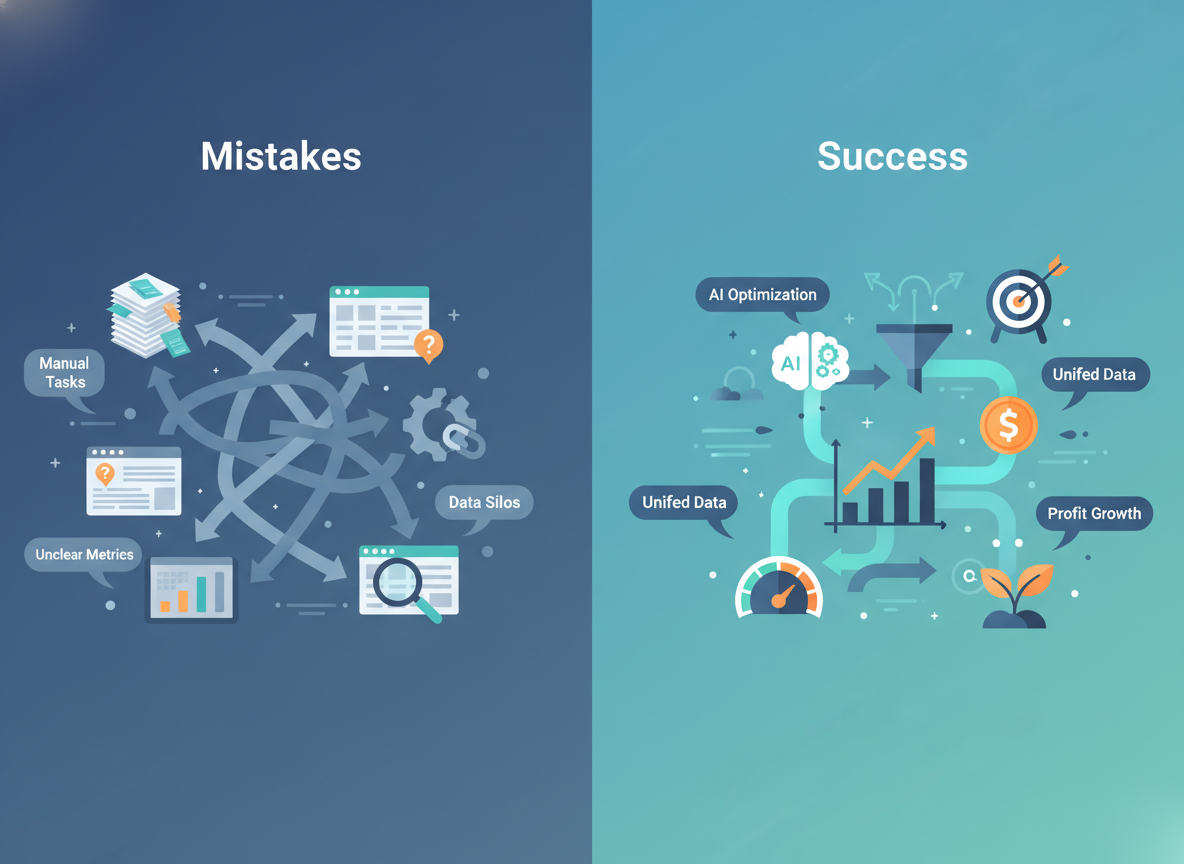
Mistake 1: Over-reliance and Lack of Human Oversight
The biggest mistake is treating AI as a fully autonomous system that requires no human intervention. AI tools are only as good as the data they are fed and the parameters they are given. Without human oversight, AI can make costly errors or miss strategic opportunities. Always review AI-generated reports and recommendations. In our experience, combining AI insights with human strategic thinking yields the best results. Always remember that AI is a tool, not a replacement for your business acumen.
Mistake 2: Using AI Without Clear Goals
Implementing AI without defined objectives is like sailing without a compass. You might be moving, but you won't know if you're heading in the right direction. Ensure your goals (e.g., increase ROAS, drive sales, reduce ACOS) are clearly defined before you start using AI tools. This clarity will allow you to configure the AI correctly and measure its effectiveness accurately. Without clear KPIs, it's impossible to determine if the AI is truly contributing to your bottom line.
Mistake 3: Poor Data Quality or Insufficient Data
AI algorithms learn from data. If the data fed into the AI is incomplete, inaccurate, or outdated, the AI's outputs will be flawed. This can lead to poor decision-making in your PPC campaigns. Ensure your Amazon Ads account is properly set up to collect comprehensive data, and that the AI tool you choose can access and process this data effectively. For instance, inaccurate conversion tracking can severely skew AI recommendations. A well-maintained data foundation is critical for AI success.
Mistake 4: Not Understanding the AI Tool's Capabilities
Different AI tools offer varying levels of sophistication and functionality. Some might focus solely on automated bidding, while others offer advanced predictive analytics. Sellers often make the mistake of expecting a tool to perform functions it wasn't designed for. Take the time to understand what your chosen ppc amazon tool can and cannot do. Read the documentation, utilize customer support, and conduct thorough testing to ensure you're using the tool as intended. This avoids disappointment and ensures you're maximizing its potential.
Mistake 5: Ignoring Market Shifts and Seasonality
While AI can adapt to many changes, it might not always intuitively grasp unique market shifts or extreme seasonality without guidance. For instance, a sudden competitor price drop or a unique holiday demand surge might require manual strategic input. Ensure your AI settings are flexible enough to accommodate these events, or be prepared to step in and make manual adjustments when necessary. Human intuition and awareness of external factors remain critical. For example, during major sales events like Prime Day, AI needs to be properly configured to handle the increased traffic and competition.
The Future of AI in Amazon PPC
The integration of AI into Amazon PPC is not a fleeting trend; it's the future of advertising on the platform. As AI technology continues to advance, its capabilities and impact on Amazon advertising will only grow more profound.
We anticipate even more sophisticated AI applications emerging, such as hyper-personalization of ads based on individual customer journeys, advanced fraud detection, and seamless integration with other marketing channels. The landscape is constantly evolving, and staying ahead requires embracing these innovations. According to HubSpot's 2026 State of Marketing report, 64% of marketers now use AI tools, a number that is expected to rise sharply.
Increased Automation and Sophistication
Expect AI to handle an even greater share of day-to-day PPC management, allowing sellers to focus purely on high-level strategy and product development. This includes more advanced automated bidding, audience segmentation, and budget allocation across entire product portfolios. The sophistication of AI algorithms will improve, leading to more nuanced decision-making and better prediction accuracy. This means less manual intervention and more intelligent campaign performance. The use of amazon ads automation will become even more critical.
Hyper-Personalized Customer Journeys
AI will enable advertisers to create highly personalized ad experiences for individual shoppers. By analyzing vast amounts of data on customer behavior, preferences, and purchase history, AI can tailor ad content, offers, and timing to each user, leading to unprecedented levels of engagement and conversion. This moves beyond basic segmentation to true one-to-one marketing at scale.
AI-Powered Competitor Analysis and Strategy
The future will see AI tools offering more comprehensive competitor analysis, identifying their strategies, pricing, and advertising tactics in real-time. This will empower sellers to react more effectively to market dynamics and develop more robust competitive strategies. AI can help predict competitor moves, allowing businesses to proactively adjust their own campaigns. This level of strategic insight is crucial for maintaining a competitive edge.
Frequently Asked Questions
The primary benefit of AI for Amazon PPC is enhanced efficiency and profitability. AI automates complex tasks like bidding and targeting, optimizes ad spend in real-time, and uncovers performance insights that human analysis might miss. This leads to higher conversion rates, reduced advertising costs, and ultimately, maximized profits.
While AI can automate many tasks, it's unlikely to fully replace human PPC managers. AI excels at data analysis and execution but lacks the strategic foresight, creative problem-solving, and nuanced understanding of brand voice that humans provide. The most effective approach combines AI's power with human expertise for strategic oversight and decision-making.
Results can vary, but many sellers see improvements within the first 30-45 days of implementing AI-powered Amazon PPC strategies. Initial results often involve improved keyword targeting and bid optimization, leading to better ad performance. Significant profit maximization and sales growth typically occur with sustained use and refinement of AI tools.
An essential AI-powered Amazon Ads campaign tool should offer features like automated bidding, intelligent keyword research, predictive analytics for forecasting, dynamic creative optimization, and portfolio management capabilities. It should also provide robust reporting and analytics to track performance and inform strategy. Look for tools that leverage machine learning for continuous improvement.
The cost of AI for Amazon PPC varies significantly depending on the provider and the features offered. Some tools are subscription-based with tiered pricing, while others might charge a percentage of ad spend. Many offer free trials or basic tiers, allowing sellers to test the waters before committing. The investment often pays for itself through improved ROAS and reduced wasted ad spend.
AI for Amazon PPC indirectly drives organic sales by improving ad relevance and conversion rates. When your ads are highly targeted and effective, they lead to more sales, which signals to Amazon's algorithm that your products are in demand. This increased demand and positive sales velocity can boost your product's organic ranking in search results, leading to more organic sales.